OneScholar: In-browser literature access, metrics and integrity tools for researchers
OneScholar, developed by SCI Great, is a browser extension that centralizes literature discovery and reference management for academic researchers. It provides in-browser evaluation and access cues to reduce manual cross-checking during literature reviews. The app combines citation indicators, access links, export utilities, and translation/summarization aids to speed screening and citation preparation. PhD students, faculty, and medical professionals who review many papers gain faster triage inside standard search workflows.
How does the app surface full text and evaluation data in search results?
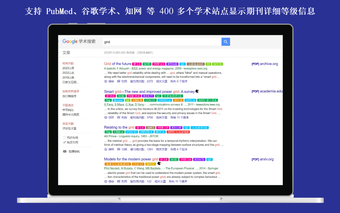
It overlays journal rankings, citation counts, and direct download links onto search results from databases such as PubMed and Google Scholar, placing indicators and access buttons inside result listings. The overlay pulls data from both Chinese sources and international indexes to present publication year and Impact Factor cues alongside titles. Built-in sorting and filtering let users reorder results by metrics or date without leaving the search page, reducing manual cross-referencing.
What permissions and configuration does the app require?
The extension runs inside the browser and requires permission to read page content and inject overlays, which enables one-click access buttons and metric displays. Custom translation and AI summary features accept user-supplied API keys for engines such as OpenAI and DeepSeek, so users must configure external credentials to use those options. The tool lists compatibility with Firefox 78 and later and offers builds for other major browsers.
How broad is its database coverage and reference export support?
Coverage spans over 400 academic websites and databases, including Google Scholar, PubMed, Web of Science, Scopus, CNKI, ResearchGate, and Semantic Scholar, allowing cross-source lookup inside one interface. Citation export supports EndNote, Zotero, Mendeley, BibTeX, RIS, and GB/T 7714 formats, and the extension offers direct import hooks for popular reference managers. This combination reduces manual export steps and fits workflows that depend on standardized reference formats.
What legal and integrity implications should researchers consider?
The app integrates integrity signals from PubPeer, Amend, and Retraction Watch to flag disputed or retracted papers directly in search results, aiding source vetting. It also surfaces one-click full-text routes via Sci-Hub, Unpaywall, and institutional repositories, which raises jurisdiction-dependent legality questions for some users. AI-powered summaries use GPT technology and configurable translation APIs, so researchers should consider institutional rules and data-sharing preferences before routing manuscript text to external services.
OneScholar is a practical choice for rapid in-browser literature triage
For doctoral researchers, faculty, and clinicians who need faster screening of search results, the app is a practical option that shortens triage and citation preparation. Its model depends on external data providers and configurable third-party services, so group policy and legal context should guide deployment. Users who need formal archival provenance should combine the app with institutional verification workflows before adoption.